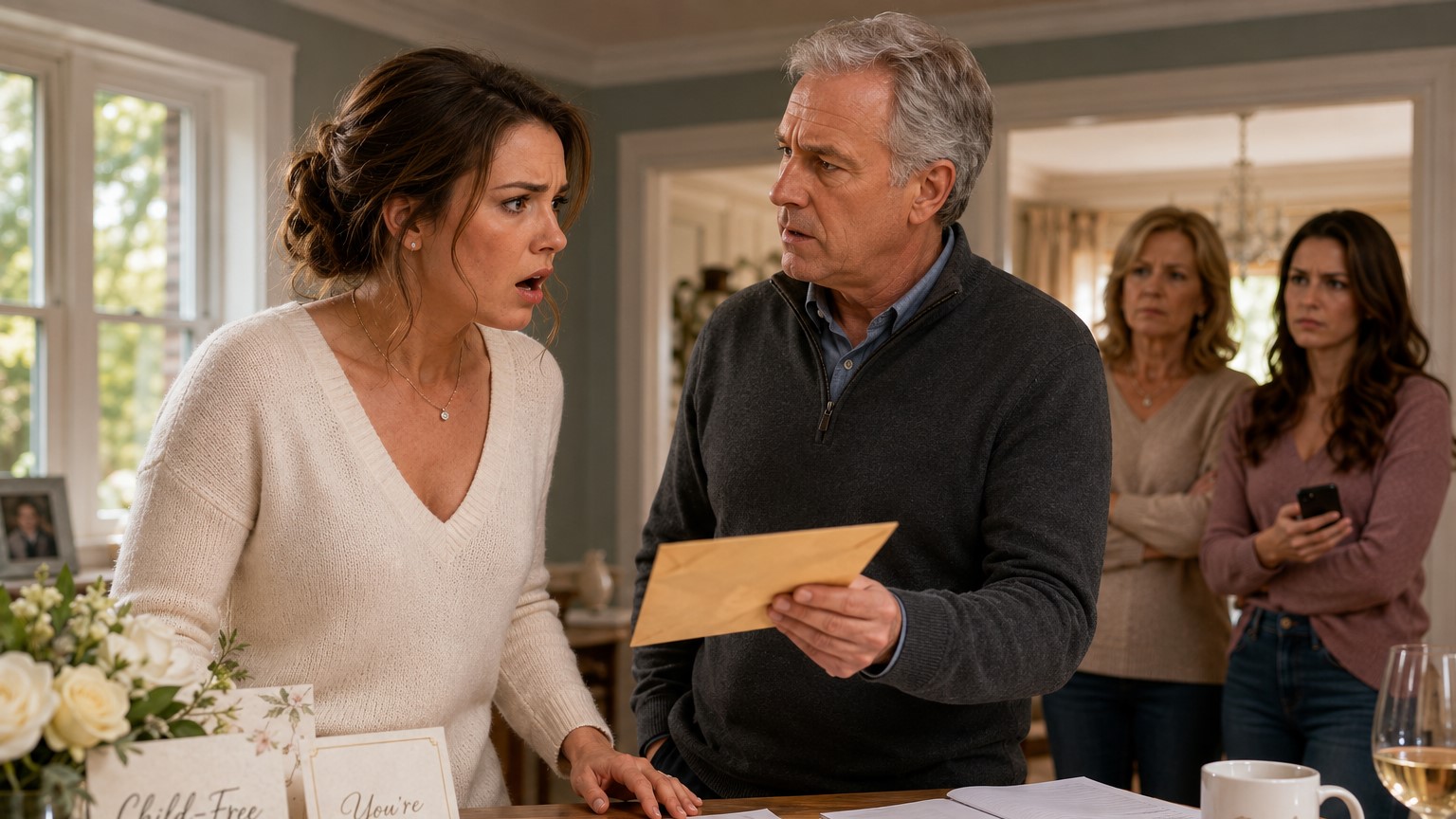
The first thing my sister said when she called me three days before my wedding was, “You’re going to have to make an exception.” I was standing barefoot in my kitchen, staring at the seating chart spread across the counter, with a half-finished cup of coffee going cold beside me. “An exception to what?” I asked. “To the no-kids rule.” My stomach dropped. For almost a year, everyone in my family had known that my wedding was going to be child-free. It wasn’t a secret, and it wasn’t some last-minute rule designed to exclude my sister’s children. My fiancé and I had chosen a small evening ceremony at an elegant historic venue because we wanted one quiet, meaningful night surrounded by the adults closest to us.
My sister had three children, ages four, six, and eight, and I loved them deeply, but loving them didn’t mean changing the wedding we had spent months planning. When I asked what had happened, she told me her babysitter had canceled. I sympathized, but before I could finish my sentence, she said, “So we’re bringing them.” I actually laughed because I thought she was joking. She wasn’t. “You can’t just bring them,” I said. “Why not?” she demanded. “Because it’s a child-free wedding.” Her voice sharpened immediately. “You’re seriously going to make me choose between attending your wedding and bringing my children?” “I’m not asking you to choose,” I said. “I’m asking you to respect the invitation.” She scoffed. “An invitation isn’t a dictatorship.” By dinner that night, my mother had already called me. She told me I was being rigid, selfish, and unreasonable. I reminded her that the policy had been communicated almost a year earlier, but she kept repeating, “She has no childcare. She’s your sister.” When I finally said I wasn’t changing the rule three days before the ceremony, my mother replied, “You’re destroying your own family over three children.” The next morning, my sister announced in the family group chat, “We’ll be bringing the kids Saturday. Hope everyone can be understanding.” My mother immediately responded, “Of course. Family comes first.” I sat there staring at those words until my hands began to shake. I finally replied that the wedding remained child-free. My sister answered, “Fine. Then maybe I shouldn’t come either.” I spent the rest of the afternoon wondering how a simple boundary had somehow turned me into the villain. That evening, my father asked me to meet him outside. He looked unusually serious when he handed me a folded envelope. Inside was a receipt for another venue, paid in full. “Dad… what is this?” I asked. He looked toward the house and lowered his voice. “The wedding venue your mother and sister think you’re having? That isn’t where you’re getting married.” Before I could understand, he explained that he had learned something disturbing. My sister had sent my mother a voice recording, apparently without realizing Mom would forward it to him. Dad pressed play. My sister’s voice came through the phone: “I’m bringing the kids. She’ll get over it.” Then my mother answered, “She has to. Everyone will be there.” The recording continued, revealing that they planned to place my sister and the children near the front so that if staff objected, removing them would cause such a public scene that I would supposedly surrender. My sister even joked that once everyone arrived, I wouldn’t have the nerve to throw them out. Then came the part that made my father’s face harden. My sister mentioned that Mom “already knew someone there” and could handle any problems with the venue. I felt sick. This wasn’t an accidental misunderstanding. They had planned to corner me emotionally in front of my guests until I gave in.
My father told me he had prepared a second location after hearing the recording. He had reserved a private venue, paid the deposit in full, arranged for professional security, and instructed them to admit only guests whose names appeared on the final list. I could barely process what he was telling me when my sister called. “Dad told you, didn’t he?” she asked. “How do you know?” I replied. She sounded angry rather than embarrassed. “Because Mom just called me screaming.” When I asked what they had been planning, she suddenly became quiet. Then she said, “You really think you’re going to get away with this?” My father stepped beside me and told her, “I protected my daughter.” She went silent. Then she whispered, “Dad… you don’t know what Mom already did.” She hung up before explaining. Seconds later, my fiancé came through the front door holding his phone, his face pale. “There’s a problem,” he said. “The original venue just called. They said someone claiming to be you tried to cancel the wedding.” My heart seemed to stop. I called the venue myself, and the manager confirmed that a woman had contacted them earlier, identified herself as the bride, and demanded that the entire reservation be canceled. She had apparently told them there was a family emergency and that the wedding would not be taking place. Fortunately, the venue manager had noticed that the caller’s information didn’t match the documentation on file and had refused to process the cancellation without written confirmation from me. My father immediately told me to save every message, screenshot, recording, and email. The next morning, we contacted the venue and requested copies of all correspondence connected to the attempted cancellation. We also discovered that my mother had contacted two vendors, telling them that the wedding had been “called off” and that they should stop preparations. One florist had already paused the order. A transportation company had received a cancellation request as well. At that point, my fiancé and I stopped trying to reason with my family and started protecting ourselves. We changed passwords on every wedding account, notified every vendor that no changes were authorized without direct confirmation from either of us, and sent a formal written notice to the original venue explaining the situation. My father also arranged for an attorney to review what had happened. We learned that although the attempted cancellation itself hadn’t caused a permanent financial loss, knowingly impersonating us to interfere with contracted services could create serious legal consequences depending on the evidence and jurisdiction. We weren’t interested in revenge, but we wanted a clear record. Then my sister made one final mistake. She sent me a message saying, “You are humiliating Mom. She only tried to fix your wedding.” I replied with one sentence: “If she was trying to fix my wedding, why did she pretend to be me?” There was no answer. Instead, my mother called and accused me of turning my father against the family. She insisted the recording had been taken out of context. When I asked what part of the recording justified pretending to be me and attempting to cancel my venue, she changed the subject. Finally, I told her that my wedding was no longer open for negotiation. She could attend under the same rules as every other guest, or she could stay home. There would be no exceptions, no surprise children, and no unauthorized changes. She hung up on me.
Two days later, we moved forward with the backup plan. Our guests received a simple message explaining that the ceremony location had changed for logistical reasons. We deliberately didn’t send details to anyone who might interfere until the last possible moment. On the wedding day, I woke before sunrise with a strange mixture of exhaustion and peace. For months, I had imagined walking into that historic venue, but now I was getting ready somewhere completely different. My father came to see me before the ceremony. He didn’t tell me everything would be fine. Instead, he said, “Whatever happens today, remember that nobody gets to take this day away from you.” When we arrived at the private venue, security checked every guest against the approved list. Most people understood immediately why the precautions were necessary. My sister never appeared. Neither did my mother. I expected to feel devastated, but what I felt most strongly was relief. The ceremony itself was beautiful. My fiancé and I exchanged vows beneath soft evening lights, and for the first time in weeks, I wasn’t wondering who was going to create the next crisis. I was simply present. Afterward, my father quietly handed me a folder containing the documentation he had collected: the recording, screenshots, vendor correspondence, the attempted cancellation, and the written confirmation from the original venue. He told me that if we wanted to pursue the matter, everything was ready for an attorney. We eventually did have the attorney send a formal cease-and-desist letter demanding that my mother and sister stop representing themselves as authorized decision-makers for our contracts and wedding arrangements. We also documented the financial losses caused by the attempted cancellations. The florist was able to restore our order, but we still incurred a small fee for the disruption. The transportation company reinstated our reservation after receiving direct confirmation from us. Most importantly, we established a paper trail showing exactly what had happened. My mother eventually apologized—not because she suddenly agreed with the child-free policy, but because she realized her actions had crossed a line she could no longer explain away as “family.” My sister never offered the apology I wanted. Instead, she sent a short message weeks later saying she hoped someday I would “understand her side.” I told her I did understand her side. She had a childcare problem. What I didn’t understand, and would never accept, was her decision to turn that problem into my responsibility and then manipulate everyone around us to force the outcome she wanted. We went low-contact with both of them for a while, and the distance gave me something I hadn’t realized I desperately needed: clarity. I stopped measuring my boundaries by how angry they made other people. My father later told me that the backup venue had originally been his idea after he sensed something was wrong, but he hadn’t expected the situation to escalate as far as it did. “I wasn’t trying to save the wedding,” he said. “I was trying to make sure you had a choice.” That sentence stayed with me. Because in the end, the real betrayal wasn’t that my sister wanted to bring her children. It wasn’t even that my mother took her side. The betrayal was that they believed my “no” didn’t count unless they agreed with it. They thought enough pressure, guilt, relatives, and public embarrassment would eventually make me surrender. Instead, my father made one phone call, gave me another option, and reminded me that I was allowed to protect something important without apologizing for it. Months later, the original venue refunded the remaining balance, and the attorney closed the matter after confirming there were no further attempts to interfere. My wedding photos now sit on a shelf in our home, and whenever I look at them, I don’t think about the family members who weren’t there. I remember the moment I walked through those doors and realized that the day was finally mine again. The invitation had never been a weapon. It had simply been a boundary. And for the first time in my life, my family learned that loving them did not require me to surrender it.