My mother had always mistaken my silence for weakness. She had been doing it for most of my life. My father, Daniel, died when I was six. I was too young to understand what death meant, but I understood that something enormous had disappeared from our family. After Mom married Gary, the photographs of my father slowly vanished from our house. One afternoon, I finally asked where they had gone. Mom barely looked up. “Gary is your father now.” Then Cody was born.
And somehow, overnight, we became the Marsh family..
Mom.
Gary.
Cody.
And me.
The girl with the different last name.
The daughter who belonged to the family—but never completely.
Cody got the new bicycle.
Braces.
College tuition.
Help starting his restaurant.
Whenever I needed something, Mom had the same answer.
“You’re independent.”
“You’ll figure it out.”
So I did.
I learned to take care of myself. I became an ICU nurse. I built a life without waiting for anyone to rescue me.
But there was one place where I never had to wonder whether I belonged.
My grandmother Ruth’s house.
Grandma had kept everything Mom had tried to erase.
Every photograph of my father.
Every letter.
Every little reminder that Daniel had existed—and that I had once been his little girl.
Sometimes she would take one of his photographs from the shelf, tap the glass with her finger, and look directly at me.
“Don’t you ever let anybody convince you he wasn’t real.”
When I was younger, I didn’t understand why she said it so seriously.
As I grew older, I did.
Grandma knew exactly what my mother had tried to erase.
Then Grandma got sick.
By the time I reached hospice, she was already very weak.
I sat beside her bed, holding her hand, trying not to cry.
Before I left, she closed my fingers around something small.
A tiny brass key tied to a faded blue ribbon.
I stared at it.
“What is this?”
She squeezed my hand.
“When the time is right,” she whispered, “the man will tell you the rest.”
“What man?”
But her eyes had already closed.
Those were among the last words she ever said to me.
Then she was gone.
At the funeral reception, I overheard something that made my stomach tighten.
Gary was asking Mom how quickly Grandma’s estate could be settled.
Mom answered casually.
“There’s the house and whatever she was sitting on in the bank.”
Then she added:
“Ruth always claimed she had something set aside for the girl. We’ll see about that.”
The girl.
I was thirty-four years old.
I was a registered ICU nurse.
I had supported myself for years.
But to my mother, I was still the girl.
The next morning, Mom called everyone to Grandma’s house.
She said we were going to “clean things out.”
We weren’t cleaning.
We were dividing.
Grandma’s china went to Mom.
Furniture went to Cody’s restaurant.
The television went to Gary.
And my father’s photographs were stacked face down beside the door.
I stood there watching pieces of Grandma’s life disappear into boxes.
Then Mom found the banking papers.
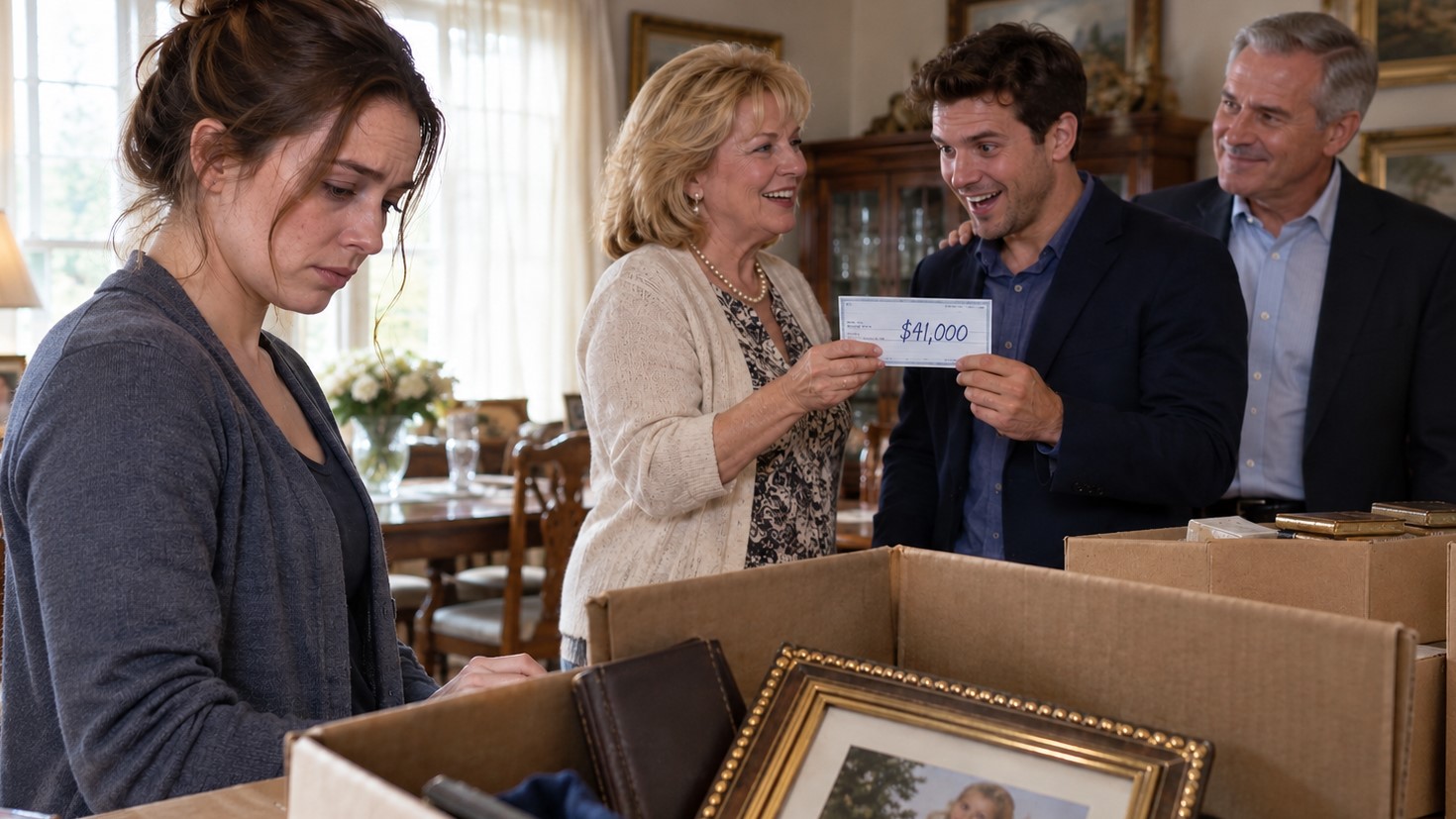
Ten minutes later, she handed Cody a check.
$41,000.
I stared at the number.
Cody stared at the check.
Then he looked at Mom.
She smiled.
“His business is drowning,” she said. “Your little savings can wait.”
Gary nodded in agreement.
As though the decision had already been made.
As though the money had always belonged to them.
I looked at my mother.
She didn’t look guilty.
She looked justified.
I didn’t argue.
I didn’t raise my voice.
I didn’t demand the check back.
I simply picked up the box containing my father’s photographs and walked out.
Mom probably thought I had finally accepted my place.
She was wrong.
Instead of driving home, I called my father’s sister, Rosemary.
I told her what had happened.
Then I mentioned the brass key.
The line went completely silent.
For several seconds, Rosemary said nothing.
Finally, she whispered:
“Then Ruth did it.”
“Did what?”
“She kept Daniel’s money safe.”
I pulled my car onto the shoulder.
“What money?”
Rosemary took a breath.
She told me the brass key opened a safe-deposit box Grandma had maintained for twenty-eight years.
Twenty-eight years.
Exactly how long it had been since my father died.
“Everything is inside,” Rosemary said.
“The proof of where it came from.”
She paused.
“And who it was always meant for.”
A few days later, I went to the bank.
I placed the tiny brass key into the lock.
Inside the box was a photograph.
My father was standing waist-deep in a green lake, with five-year-old me sitting on his shoulders.
I hadn’t seen that picture in years.
I stared at it until my eyes burned.
It was one of those memories Mom had spent years making me feel almost guilty for holding onto.
Then I noticed the envelope underneath it.
I recognized the handwriting immediately.
My father’s.
Two words were written across the front.
**For Thea.**
My hands began to shake.
Inside, Dad explained that shortly before his death, he had purchased a life-insurance policy.
The money was intended for one person.
Me.
He had named Grandma as the beneficiary because he trusted her to protect the money until I was old enough to manage it myself.
Then I found the financial records.
The insurance payout had been exactly $41,000.
Grandma had placed exactly $41,000 into a separate account.
She had never mixed it with her own money.
Never spent it.
Never transferred it.
For twenty-seven years, she had protected it.
Every statement carried the same handwritten note:
**“Daniel’s insurance for Thea.”**
There were years of statements.
And then I found something else.
Something Grandma had clearly written because she knew exactly what might happen after she died.
A notarized letter.
“These funds were never mine,” she had written.
“They belong to Thea.”
Then came the sentence that changed everything.
“If anyone touches them after I’m gone, Howard, bring them back to her and read this aloud so everyone hears whose money it was.”
Howard Pratt was Grandma’s attorney.
He was also the executor of her estate.
I called him immediately.
I told him about the $41,000.
I told him about the check Mom had handed Cody.
I told him about the brass key.
Howard listened without interrupting.
Then he gave me three instructions.
“Come to the estate reading.”
“Sit down.”
“And say nothing until I finish.”
Three weeks later, we gathered around Grandma’s old oak kitchen table.
Mom sat in Grandma’s chair.
Gary sat beside her.
Cody sat at the far end.
Rosemary sat beside me.
Before Howard arrived, Mom slid a document across the table.
“Family Settlement Agreement,” she said.
Gary’s cousin was there with a notary stamp.
“Just sign it,” Mom told me. “Let’s keep lawyers out of this.”
I picked it up.
I read every line.
Buried in the middle was a clause stating that I would waive my rights to any other account or fund connected to Grandma’s estate.
Known or unknown.
My name had already been typed beneath the signature line.
Gary pushed the pen toward me.
“Stop making this difficult.”
I didn’t touch it.
Then the kitchen door opened.
Howard Pratt walked in.
He looked at the document.
Read it once.
Then calmly slid it back toward Mom.
“Put this away.”
Mom’s expression changed.
Howard continued.
“And do not ask her to sign anything before I finish.”
For the first time, Mom looked uncertain.
But she still smiled.
She thought she knew exactly what was coming.
Howard began reading the estate documents.
First came the house.
It had been left jointly to me and Rosemary.
Then Grandma’s rings.
Her recipe box.
And every photograph of my father.
All of them were mine.
Mom’s smile weakened.
But she kept waiting.
She was waiting for the money.
Finally, Howard reached for a second folder.
“This concerns account number ending in 4208.”
My mother leaned forward.
That was the account she had emptied.
Howard opened the folder.
The room became completely silent.
Then he began reading Grandma’s final statement.
“The funds in this account are not mine and never were. They are the proceeds of a life-insurance policy taken out by my son Daniel Linfist before his death…”
My mother’s smile froze.
Howard continued.
“Designated by him for one person only.”
Then he looked directly across the table.
“His daughter, Thea.”
Nobody moved.
Nobody spoke.
For the first time that day, my mother looked frightened.
Howard laid the documents across the table one by one.
The insurance records.
The beneficiary documents.
The bank statements.
Grandma’s notarized letter.
Her signed instructions.
Everything matched.
The $41,000 wasn’t Grandma’s personal savings.
It wasn’t family money.
And it wasn’t my mother’s money to redistribute because Cody’s restaurant was struggling.
It was money my father had deliberately set aside for me.
Grandma had protected it for decades.
Mom had taken it and handed it to Cody in less than ten minutes.
Howard explained that Grandma had documented everything before her death.
The source of the money.
The ownership.
The records.
And exactly what was supposed to happen if anyone tried to take it.
If the money wasn’t returned, the matter could move into a civil lawsuit and potentially a court hearing.
Suddenly, the confidence around the table disappeared.
Gary, who had supported the transfer, stopped looking so certain.
Cody stared at the table.
Mom tried a different approach.
She accused me of attacking my own family.
She said I was choosing money over my brother.
She made it sound as though I had somehow become the problem.
I looked at her.
“I don’t want revenge.”
“I don’t want you punished.”
“Howard is simply doing his job.”
He was carrying out Grandma’s instructions.
Nothing more.
Nothing less.
Four months later, Mom and Gary refinanced their home.
They repaid every dollar.
They chose to return the money rather than defend their actions in court.
Cody’s restaurant closed that fall.
I never celebrated that.
I never wanted my brother to lose his business.
I simply refused to let his financial problems become my father’s sacrifice.
I used part of the recovered $41,000 as a down payment on a modest house.
This time, there was only one name on the deed.
Mine.
The rest went into a protected savings account.
I labeled it in the same careful handwriting Grandma had taught me as a child.
Rosemary and I kept the family house.
Eventually, we put my father’s photographs back on the walls my mother had emptied years earlier.
For the first time, his face was everywhere.
Not hidden.
Not turned face down.
Not treated like an inconvenience.
Visible.
Remembered.
Loved.
Cody eventually sent me a short apology.
He said he hadn’t understood where the money came from.
I chose to believe him.
But I never resumed contact with my mother.
Not because I wanted to punish her.
Not because I wanted revenge.
I simply no longer wanted to build my life around promises that someone else could rewrite whenever it suited them.
On my nightstand, I still keep the brass key Grandma gave me.
It’s tied to the same faded blue ribbon.
The safe-deposit box is empty now.
There is nothing left inside for me to discover.
But I keep the key anyway.
Because it reminds me of something Grandma understood long before I did.
She knew what was happening.
She knew my father had wanted to protect me.
She knew the money belonged to me.
And she knew that after she was gone, someone might try to take it away.
So she prepared the truth.
She documented it.
She locked it somewhere safe.
And she left instructions for exactly when it needed to be revealed.
My mother thought she was giving my brother a second chance.
She thought my silence meant I had accepted what she had done.
She thought the money was hers to give.
But she had forgotten one thing.
My grandmother had spent twenty-eight years making sure the truth couldn’t disappear with her.
And when the time finally came, all it took was a tiny brass key, a sealed folder, and one sentence spoken aloud around an old kitchen table.
The money had never been my mother’s to give.
It had never been Cody’s to keep.
It had always been my father’s gift to his daughter.
It had always been mine.